


Table of Contents
🚀Want to get started with RCS messaging? Share your details and we'll help you set it up!
Introduction:
As businesses look for richer, more engaging ways to communicate with their customers, Rich Communication Services (RCS) is emerging as the next evolution of business messaging. Unlike traditional SMS, RCS enables branded messages with logos, carousels, quick-reply buttons, and verified sender identities — all delivered natively in the user’s messaging app. For SaaS platforms serving multiple business clients, implementing RCS at scale requires a carefully designed multi-tenant architecture that keeps each client isolated, compliant, and properly verified. This guide walks through everything you need to know — from account structure to approval timelines.
What is RCS Business Messaging?
RCS (Rich Communication Services) is an upgrade to standard SMS that brings app-like experiences to the native messaging inbox. It allows businesses to send messages with:
- Branded sender profiles — verified business name and logo
- Rich media — images, videos, carousels, and action buttons
- Read receipts and delivery confirmation
- Two-way conversational messaging
RCS messages are delivered over data (Wi-Fi or mobile data) and fall back to SMS/MMS when RCS isn’t available on the recipient’s device.
Multi-Tenant RCS Architecture
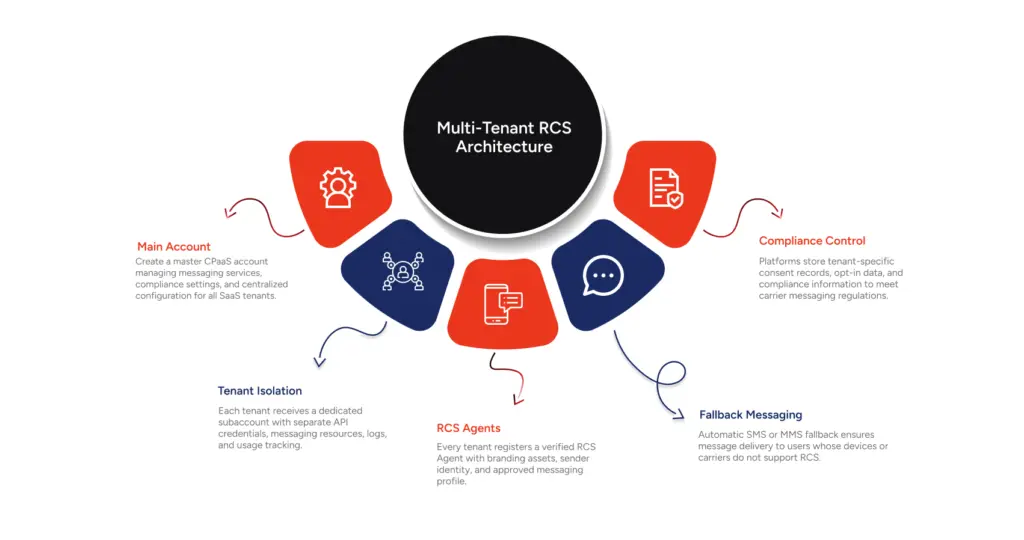
The recommended architecture for multi-tenant RCS implementation is built around a master CPaaS account with tenant-level subaccounts. This model provides full isolation between tenants while enabling centralized platform management. The core components of the architecture are:
- Main account with a CPaaS provider (e.g., Twilio)
- Subaccounts per tenant, each owning API keys and message credits
- Each tenant’s brand registered via a distinct RCS Agent
- Fallback channels (SMS/MMS) bundled with RCS for non-RCS devices
- Compliance and consent storage maintained per tenant
U.S. RCS Providers Comparison
| Provider | Strengths |
|---|---|
| Twilio | Developer-friendly APIs, multi-tenant subaccount support, RCS in production |
| Sinch | Strong enterprise reach, global footprint, RCS with fallback |
| Infobip | RCS across all major U.S. carriers, extensive global coverage |
Account Setup Approach
1. Main Account Setup
- Create a master account with your chosen CPaaS provider (e.g., Twilio)
- Enable messaging service modules — SMS and RCS Business Messaging
- Configure compliance parameters including brand identity, use case, and consent workflows
2. Tenant Isolation via Subaccounts
For each SaaS tenant, the following must be provisioned:
- A dedicated subaccount under the master account
- Unique API credentials per subaccount
- Assigned messaging resources — phone numbers and sender IDs
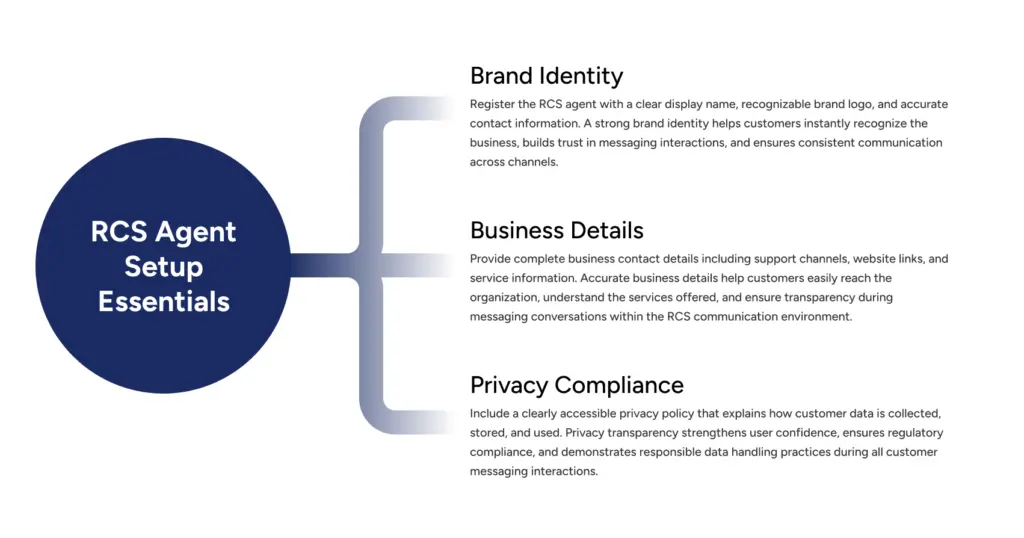
3. Brand Identity & RCS Agent Registration
- Each tenant must register a Brand and RCS Agent independently
- Submit compliance information for each tenant to the CPaaS provider
- The client’s brand becomes the verified sender for all outgoing RCS messages
4. Fallback & Multi-Channel Messaging
- Implement fallback logic to SMS/MMS when RCS is not available on a device
- Most CPaaS providers including Twilio support automatic fallback through their APIs
How the RCS Approval Process Works (United States)
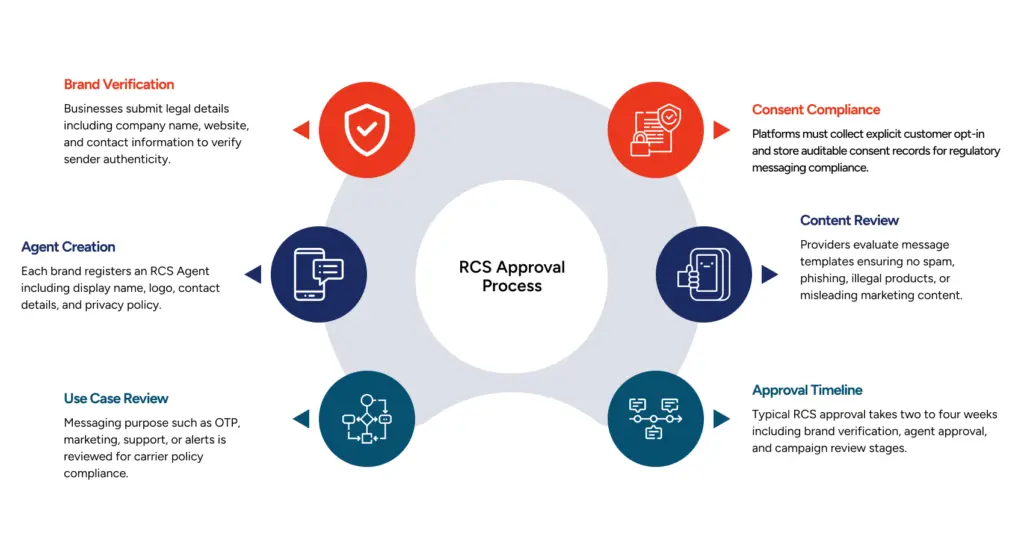
Getting RCS enabled for a tenant involves a multi-step approval process. Here’s what each stage looks like:
1. Brand Verification
The tenant’s legal business details company name, website, and contact information — are submitted for verification. This confirms the sender identity is authentic and prevents spoofing.
2. RCS Agent Creation
An RCS Agent is a verified sender profile created per brand. It includes the display name, logo, branding assets, contact information, and privacy policy URL. The agent must be approved before any messages can be sent.
3. Use-Case & Campaign Review
The messaging use case (OTP, marketing, transactional, customer support, etc.) is reviewed by the provider. They validate the opt-in collection method, message templates, and carrier policy compliance before granting production access.
4. Opt-In Compliance Validation
Explicit user consent must be documented and auditable. Opt-in records are stored by the SaaS platform on a per-tenant basis, ensuring each business remains independently compliant.
Advantages of Subaccount Architecture
Building your multi-tenant RCS platform on a subaccount model provides significant operational and compliance benefits:
- Data Governance – Establishes policies, roles, and standards to ensure data integrity, security, and compliance across the organization.
- Data Integration – Consolidates data from multiple sources, creating a unified and consistent view for seamless accessibility and usage.
- Data Quality Management – Detects and resolves errors, duplicates, and inconsistencies to maintain high-quality, accurate, and reliable data.
- Master Data Repository – Serves as a centralized storage system for validated and standardized master data, ensuring consistency across applications.
- Security & Compliance – Implements data protection measures, access controls, and regulatory compliance frameworks to safeguard sensitive information.
RCS Approval Checklist (U.S.)
Before submitting for RCS approval, ensure each tenant has the following ready:
Business Identity
- Legal company name, brand name, official website
- Business registration number / EIN
- Registered address, country of incorporation, industry classification
Brand Profile
- RCS Agent name, high-resolution square logo (PNG)
- Brand description, privacy policy URL, terms of service URL
Messaging Use Case
- Category (Transactional / OTP / Support / Promotional)
- Detailed use-case description with 3–5 example messages
- Target audience, expected monthly volume, message frequency per user
Opt-In Compliance
- Screenshot of the opt-in flow
- Opt-in disclosure text and opt-out mechanism
- Consent storage method
Technical Integration
- Webhook URL configured
- API credentials created
- RCS agent configured
- SMS fallback enabled
RCS Verification Timeline
| Stage | Typical Duration |
|---|---|
| Brand Verification | 3–7 days |
| RCS Agent Review | 5–10 days |
| Use-Case & Campaign Approval | 5–10 days |
| Total Estimated Time | 2–4 weeks |
SMS Fallback: A2P 10DLC Registration
Not all devices support RCS messaging. To ensure message delivery, platforms implement SMS fallback mechanisms.
When RCS is unavailable:
The system automatically switches to SMS or MMS.
Messages are delivered using A2P 10DLC registered numbers.
A2P 10DLC (Application-to-Person 10 Digit Long Code) is a messaging framework used in the United States to send business SMS messages while complying with carrier regulations.
Benefits include:
Higher message throughput
Improved delivery rates
Regulatory compliance
Cost-effective messaging for businesses
Conclusion
RCS messaging is rapidly becoming a key channel for modern customer communication. For SaaS platforms serving multiple clients, implementing a multi-tenant RCS messaging architecture ensures scalability, compliance, and operational efficiency.
By integrating with CPaaS providers, isolating tenants through subaccounts, registering verified RCS agents, and implementing SMS fallback mechanisms, businesses can deliver reliable and interactive messaging experiences to their customers.
Organizations that adopt this approach gain a competitive advantage by enabling rich, branded, and compliant communication across multiple clients and messaging channels.