


Introduction:
Artificial Intelligence (AI) is revolutionizing business operations and driving significant growth across industries. The global AI market, valued at approximately USD 196.63 billion in 2023, is projected to reach USD 1,811.75 billion by 2030, growing at a CAGR of 36.6% from 2024 to 2030. However, successful AI integration requires more than just technological investment. A strategic AI adoption framework ensures meaningful and scalable impact. Let’s explore the top components that drive successful AI integration.
What is an AI Adoption Framework
An AI Adoption Framework is a strategic roadmap that guides organizations through the process of integrating artificial intelligence technologies into their operations. It outlines the steps, best practices, tools, and considerations necessary to ensure successful and sustainable AI deployment.
Think of it as a blueprint that aligns AI initiatives with your business objectives, workforce readiness, technical infrastructure, and governance standards.
Why an AI Adoption Framework Matters
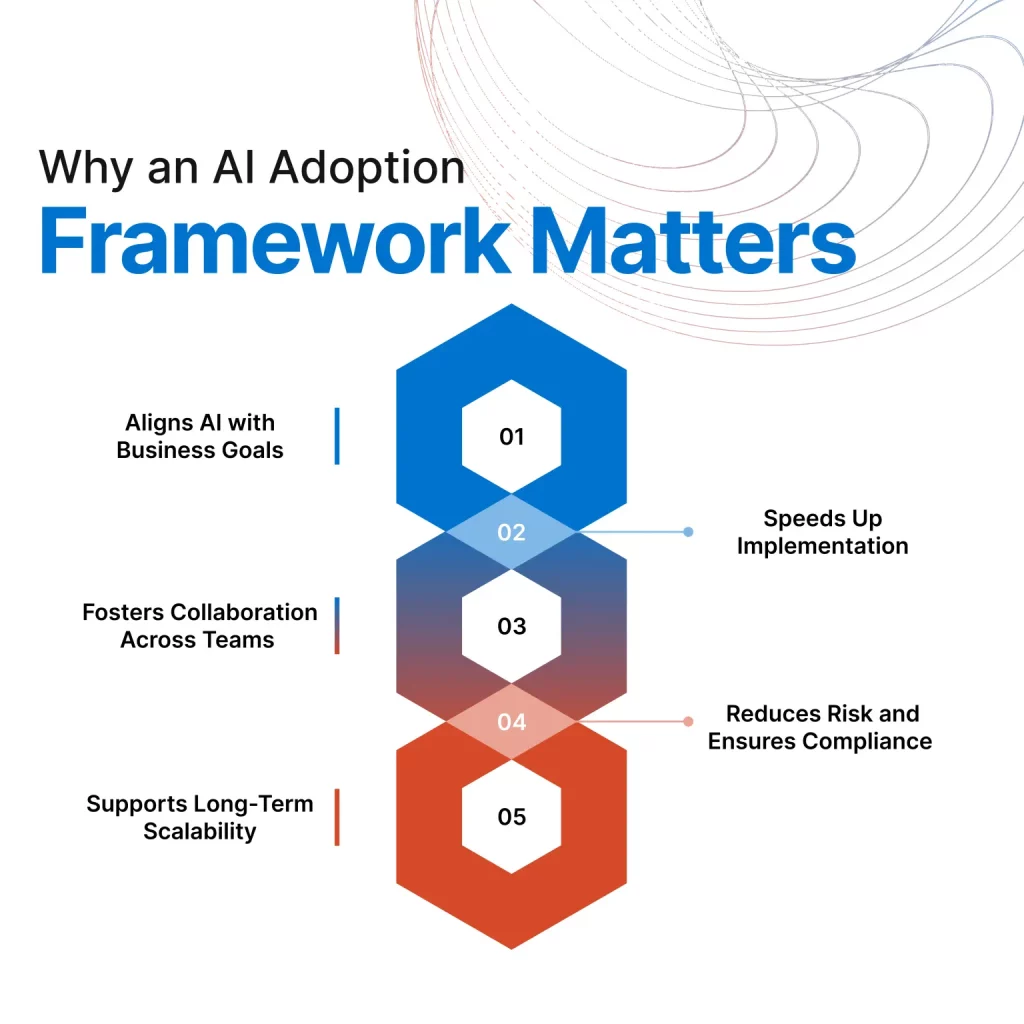
adoption strategy for enterprises. A robust AI adoption framework ensures alignment of AI with business goals, faster implementation, and cross-team collaboration. It also reduces operational risk by enforcing a strong AI governance framework and supports long-term scalability of AI initiatives. With strong executive sponsorship, data readiness, and upskilling of the workforce, this structured approach creates a clear AI implementation roadmap, ensuring enterprise AI strategy success.
1. Aligns AI with Business Goals
Without direction, AI efforts can quickly become scattered or disconnected. A structured framework ensures that AI initiatives are purpose-driven, aligning with real-world business problems and opportunities. It helps focus efforts on projects that drive measurable value—like boosting efficiency, enhancing customer experience, or increasing revenue. This alignment also makes it easier to gain executive support and ensure a better return on investment (ROI).
2. Speeds Up Implementation
AI initiatives often stall due to unclear processes or endless experimentation. A framework streamlines the journey from idea to deployment by outlining step-by-step guidance—including data readiness, tech stack, and talent needs. With a clear path, businesses can reduce delays, avoid duplication, and get results faster.
3. Fosters Collaboration Across Teams
Successful AI adoption requires cross-functional teamwork. From IT and data science to HR, legal, and operations-every department plays a role. An adoption framework fosters transparency, communication, and shared ownership, which leads to smarter, more inclusive AI solutions. The result? A culture that welcomes innovation, rather than fearing it.
4. Reduces Risk and Ensures Compliance
AI brings unique challenges-biased algorithms, data privacy concerns, and regulatory scrutiny. A well-designed framework embeds ethical standards, governance models, and compliance protocols into the AI lifecycle. This proactive approach protects both the organization and its stakeholders from legal, ethical, and reputational risks.
5. Supports Long-Term Scalability
AI success often starts with a small pilot—but scaling it across departments or regions can be tough. A strong framework offers repeatable processes, performance metrics, and scalability guidelines. With these in place, companies can confidently expand their AI footprint while maintaining quality and consistency.
Core Components of an AI Adoption Framework
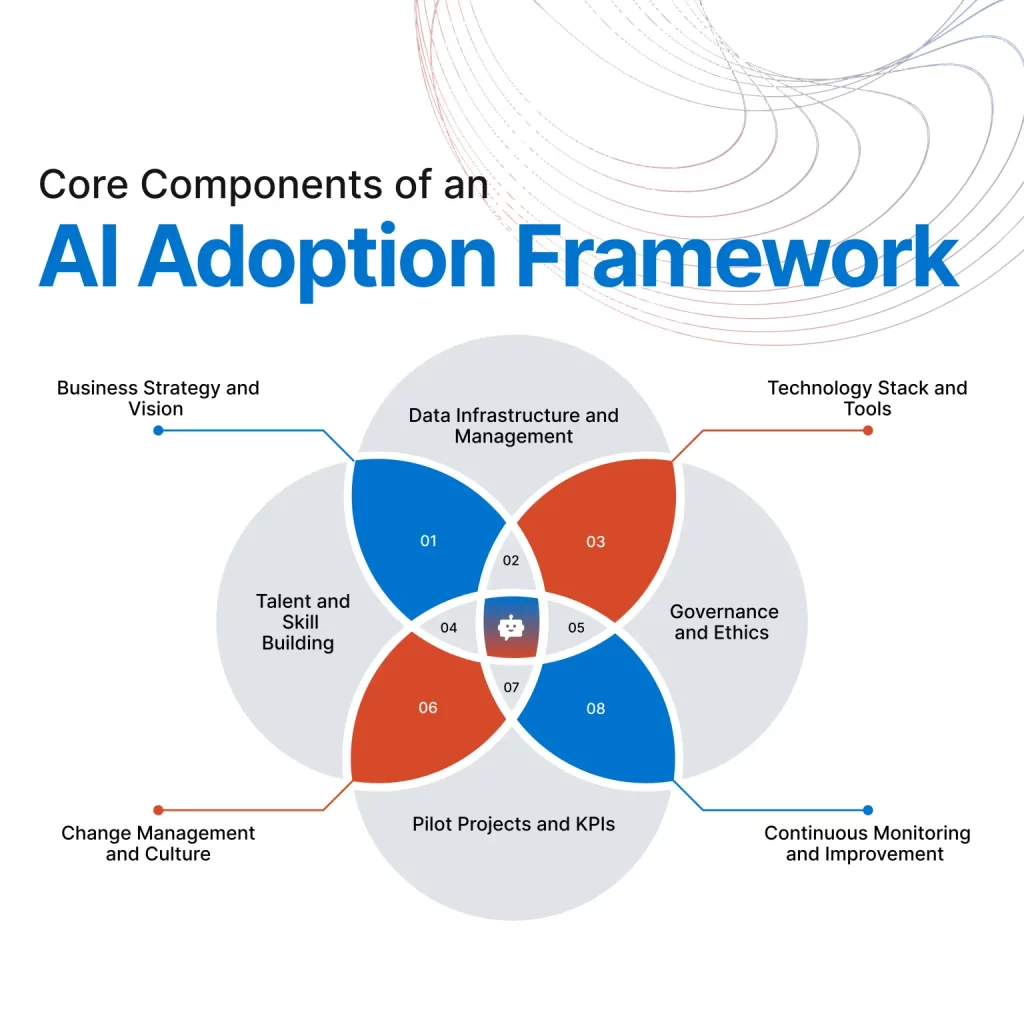
To ensure effective and responsible AI adoption, organizations should focus on these eight key pillars:
- Business Strategy and Vision
- Start with clarity. Define your strategic goals and identify high-impact areas for AI-such as customer service, finance, or supply chain. Secure leadership commitment to drive vision and direction.
- Data Infrastructure and Management
- AI runs on data. Assess your current data landscape for quality, accessibility, and compliance. Invest in scalable, secure data infrastructure to ensure reliable inputs for your models.
- Technology Stack and Tools
- Select the tools that fit your goals-cloud platforms, machine learning libraries, MLOps pipelines, and APIs. Your tech stack should support flexibility, integration, and performance.
- Talent and Skill Building
- Whether you hire new talent or upskill existing employees, having the right skills is essential. Focus on areas like data science, AI engineering, and analytics, and foster a culture of learning.
- Governance and Ethics
- Set clear policies around data use, transparency, fairness, and accountability. Adhere to regulations like GDPR or the AI Act and design your AI systems with ethical principles in mind.
- Change Management and Culture
- AI changes how people work-so prepare your teams. Offer training, support, and open communication to ease transitions and build trust. Encourage innovation, not fear.
- Pilot Projects and KPIs
- Begin with a proof of concept. Choose a use case with clear goals and track success using KPIs like accuracy, efficiency, or ROI. Use feedback to refine your approach before scaling.
- Continuous Monitoring and Improvement
- AI systems evolve-so should your approach. Monitor performance, retrain models as needed, and update your strategies to match shifting business needs or technologies.
How to Implement an AI Adoption Framework
The process of adopting AI should be intentional, inclusive, and iterative. Here’s a step-by-step guide to implement the framework:
Step 1: Conduct a Readiness Assessment
Evaluate your organization’s AI maturity. Assess gaps in data, infrastructure, culture, skills, and leadership alignment. This helps in creating a realistic roadmap.
Step 2: Define Use Cases with Business Value
Identify and prioritize use cases that are impactful and feasible. Look for repetitive, data-driven tasks where AI can bring efficiency or insights.
Step 3: Establish Governance Structures
Set up a cross-functional AI committee to oversee model development, data usage, and ethical considerations. This promotes transparency and accountability.
Step 4: Develop AI Solutions with Agile Methodology
Use agile frameworks to design, develop, and deploy AI models. Involve business users throughout the process to ensure solutions are user-friendly and relevant.
Step 5: Launch Pilot Projects
Test your AI models in a controlled setting. Measure results, gather feedback, and adjust. Pilot programs help reduce risk and improve model performance before scaling.
Step 6: Invest in Change Management
Prepare your workforce for AI integration. Run awareness campaigns, provide training, and support employees in adapting to AI-enhanced roles.
Step 7: Monitor, Measure, and Scale
Track key metrics to evaluate success. If the pilot performs well, prepare for large-scale deployment. Continue to optimize the system based on real-time insights.
Common Mistakes to Avoid in AI Adoption
While Artificial Intelligence can unlock incredible opportunities for efficiency, innovation, and decision-making, many organizations stumble during the adoption phase due to avoidable missteps. Below are some of the most frequent and critical mistakes and how to avoid them:
Starting Without a Clear Strategy
One of the most common errors is diving into AI projects without a well-defined strategy. Organizations often get excited about the possibilities of AI but fail to align initiatives with actual business goals. This results in fragmented efforts, redundant pilot programs, and tools that do not solve real problems. A clear strategy should outline business priorities, use case selection, success criteria, and how AI integrates into the broader digital transformation journey.
Overestimating Short-Term Results
AI is not a quick fix. Many organizations expect dramatic results within weeks or months of deployment, only to face disappointment when the impact takes longer to materialize. Developing, testing, and deploying AI systems especially at scale requires time, data, iteration, and refinement. It’s crucial to manage expectations, set achievable milestones, and communicate that AI is a long-term investment that delivers value gradually.
Neglecting Data Quality
AI systems are only as good as the data they are trained on. Using outdated, incomplete, inconsistent, or biased data can lead to poor performance and flawed insights. Yet, data preparation is often underestimated or overlooked. Organizations must invest in robust data governance practices, including data cleansing, integration, labelling, and compliance checks. Without high-quality data, even the most sophisticated algorithms will fail.
Ignoring Change Management
AI doesn’t just change processes, it changes people’s roles, workflows, and responsibilities. Failing to consider the human element can lead to resistance, confusion, or underutilization of AI tools. Employees may feel threatened or left behind if they aren’t informed, trained, or engaged in the change process. Effective change management includes open communication, reskilling programs, leadership support, and initiatives that encourage a culture of innovation and collaboration.
Underinvesting in Governance
Ethical and legal concerns are not optional they are central to responsible AI deployment. Yet, many companies treat governance as an afterthought, exposing themselves to reputational damage, regulatory penalties, and loss of trust. Strong AI governance includes defining ethical guidelines, ensuring transparency and accountability, managing data privacy, and monitoring models for bias and fairness. These considerations must be embedded in the AI lifecycle from the beginning, not added later as a patch.
Conclusion
Artificial Intelligence is no longer a futuristic concept, it’s a present-day game-changer for businesses aiming to stay competitive and agile. However, the key to unlocking its full potential lies not just in deploying cutting-edge tools but in adopting a thoughtful, structured, and human-centred approach. From aligning with business goals to ensuring ethical governance, every step matters in building a sustainable AI journey.
At BUSoft, we specialize in helping organizations like yours navigate the complexities of AI adoption with confidence. Whether you’re just getting started or looking to scale existing AI initiatives, our expert team can craft customized strategies that drive real results securely, ethically, and effectively.
Ready to adopt AI the smart way?
Partner with BUSoft to design, build, and scale AI solutions that truly transform your business.
Stay tuned. Master it with BUSoft.

Authored by Sesh
Chief Growth Officer